Surprise! Getting Married Might Have Zero Impact on Your Income Taxes.
Hi Friendos,
I was at a reading group recently where we discussed some essays by Alexandra Kollontai, and two people in the group made comments about how they’d had no idea that getting married would have such a big impact on their income taxes. I thought, “Did it really? Are you sure?” I don’t know people in the group very well, but I strongly suspected that before either of these commenters got married, they were child-free and working full-time, marrying someone who was also child-free and working full-time.
I also suspected that those people in my reading group were not particularly high-income and that they and their spouses earned fairly similar incomes. In that case, marriage likely had zero impact on their income taxes because the tax brackets for “married filing jointly” filing status are exactly 2x those of “single” filing status. You can see this for yourself with the 2027 tax brackets, summarized in this table from Tax Foundation:
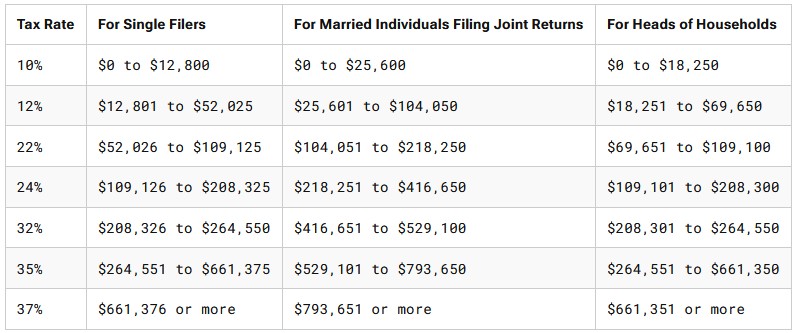
Focus on the “Single” and “Married” columns for now, just the top number of each tax bracket:
- The 10% tax rate applies to a single person’s income up to $12,800 and to income of a couple married filing jointly (“MFJ”) up to $25,600. $25,600 is exactly 2x $12,800. Put differently, the amount of MFJ income subject to a 10% federal income tax rate is exactly 2x that for Single.
- The top of the MFJ 12% tax bracket, $104,050, is exactly 2x that of Single, $52,025.
- The top of the MFJ 22% bracket, $218,250, is exactly 2x that of Single, $109,125.
- The top of the MFJ 24% bracket, $416,650, is exactly 2x that of Single, $208,325.
- The top of the MFJ 32% bracket, $529,100, is exactly 2x that of Single, $264,550.
It is not until we get to the 35% bracket that the MFJ limit is not 2x that of Single. Very few people earn that much income: fewer than 2% of tax returns, according to the most recent data from the IRS (from 2022, see Table 3.4). So we can set aside very high earners and think of tax brackets for MFJ as being twice the size of tax brackets for Single.
Let’s say someone has taxable income of $50k and they are marrying another person with taxable income of $50k. Here’s the income tax breakdown:
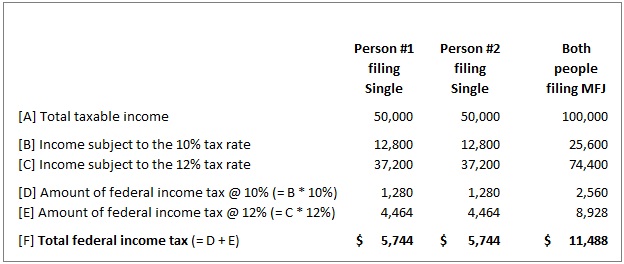
Filing Single, each person will pay $5,744 in federal income tax for a total of $11,488. If instead they were married and filed a joint tax return, they would pay federal income tax of $11,488. There is no impact of getting married.
I could construct similar examples at other levels of income. In 2027, for couples earning income falling into the same top tax bracket, there is $0 marriage impact for incomes up to $529,100.
Now, there are plenty of situations where there can be a “marriage bonus” or a “marriage penalty” because their combined taxes as Single filers differ from what they pay as Married filers. Here are some examples:
- Marriage penalty: An unmarried person with kids files Head of Household (“HoH”) and gets married, losing the benefit of the larger HoH standard deduction.
- Marriage bonus: One person has much larger income than the person they marry, allowing the combined income to “fit” into lower tax brackets.
- Marriage penalty: Two child-free people both qualify for the Earned Income Tax Credit and they get married, increasing their combined income enough to lose that refundable tax credit.
Marriage can increase or decrease the total income taxes paid by two people; it depends on the specifics. So, you might be wondering, what actually happens in real life? Earlier this year a report from the Congressional Research Service analyzed this in fascinating detail. Here are a few findings:
- “The Treasury Department’s Office of Tax Analysis has estimated that 53% of joint returns receive bonuses and 37% receive penalties,” while 10% were marriage-neutral.
- “[B]onuses and penalties are pervasive in the income tax, and marriage penalties are more significant for two-earner families, families with children, and middle-income families.”
- “The OTA estimates that the average marriage penalty was $1,820, while the average bonus was $4,911. Those estimates likely understate marriage penalties and overstate marriage bonuses, however, insofar as penalties discourage some couples from marrying, those unmarried couples will not be counted in estimates exclusively of married couples.” I will add that looking at the underlying data (see p. 10), the size of marriage bonuses and marriage penalties at different income levels are fairly similar in size, in the $1,000-$2,500 range, until you get into incomes over $100,000.
An appendix to the report provides fascinating historical context. For example, after income taxes were adopted in 1913, the Treasury Department initially assigned all community property to husbands but switched to an equal split in 1919. This equal split conferred a marriage bonus to some couples and encouraged more states to become community property states. From the 1950’s on, we had several pieces of legislation that reduced the size of marriage bonuses or recognized the cost of caring for dependents. In 2001 we got MFJ tax brackets twice as wide as Single brackets, which “eliminated marriage penalties arising from the rate structure for couples without children,” though we continue to have penalties for some Head of Household filers.
Under capitalism, the household is the key economic unit and our tax code reflects that. If we go with this and define tax fairness as relating to household income and family size, it is not possible to have an entirely marriage-neutral tax code that also has progressive tax rates. As the report states:
It is impossible to achieve a tax system that is simultaneously progressive (in terms of both effective and marginal income tax rates), horizontally equitable (households with the same income and family size pay the same taxes), and marriage neutral (couples pay the same taxes regardless of whether they are married or unmarried).
If it were up to me, I would also like to give weight to tax code simplicity, as I believe the current complexity is a meaningful burden on most Americans. Think about how much people pay for tax preparation every year!
If you are thinking about getting married, should you consider whether you’ll be subject to a marriage bonus or penalty? Probably not, but your mileage may vary. A full analysis would consider other aspects of your financial life, like the cost of medical insurance and the suite of legal rights conferred by marriage. And of course things like income and job status can change dramatically over the years. When I wanted to get married, doing an analysis like this never even crossed my mind.
-Stephanie

