No 401k Account Left Behind. Work Through the Hassle to Keep Tabs on All Your Money.
Hi Friendos,
Today’s 401k summer school is about what to do with money in a 401k after you’ve left that job. You have three options:
- Option 1: Nothing. Leave the money sitting right there in Old Job 401k account.
- Option 2: Move the money from Old Job 401k account to New Job 401k account.
- Option 3: Move the money from Old Job 401k account to IRA account.
Option 1, do nothing, is ok for the short-run, but typically not good for the long-run. If your account balance is not large, Old Job might cash it out for you and then you could end up owing taxes and penalties for early withdrawal if you don’t take prompt action…this has happened to some of my clients. Not good! Or, you could forget the money is there and not make appropriate plans as a result. It’s fine to backburner things while you get settled in a new job, but actively taking charge of that money should stay on the to-do list until it’s handled.
Options 2 and 3 are both very good options. How to choose between them? If New Job 401k has non-ideal investment options, go with option 3 (roll Old Job 401k into an IRA). If you don’t already have an IRA account and like the idea of just one account for all your retirement money, go with option 2 (roll Old Job 401k into New Job 401k). If New Job 401k does not allow you to roll money in, then they’ve selected option 3 for you (IRA rollover). Either way is fine.
In May I wrote about this process when my spouse rolled an Old Job 403b into an IRA. In some cases, you may be able to rollover an Old Job retirement account entirely online, but even if you can, I still recommend some phone calls to check over everything.
I think the best place to start is with New Job 401k Provider or IRA Provider, by calling them on the phone and explaining what you want to do. I think calling is better than browsing around their website, because even if you identify the right paperwork online, you almost certainly will have some questions about how to fill it out. You might really dislike phone calls like this (I’ll feel stupid! What if they yell at me?), but remember: the representative should be helpful because you are trying to increase the assets in their accounts, and that is how they make money. You are asking them to help you, but also asking, “Can you help me increase your profits?” They want to help you.
New Provider will probably have you fill out some paperwork, either online or a paper form you fill out and upload/snail mail to them. They may ask you the approximate amount of money you are moving over, and some questions about where it is coming from. You won’t know the exact amount due to daily fluctuations in market values, so approximations here are normal. The process is slightly different at each financial firm, and overall is annoying but you can deal with it.
Old Provider will also have you fill out some paperwork. You want to ask for a “trustee to trustee” transfer of funds or a “direct rollover.” Those are the magic words. In this scenario, no checks are made out directly to you (in your name) and your Old Provider (the financial institution with the money, aka “custodian” aka “administrator”) will be directed to send funds directly to the New Provider.
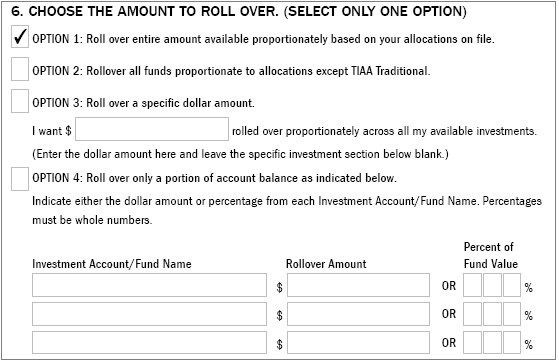
I looked at some old rollover paperwork of my own, and found forms from 3 different Old Job Providers. One was 28 pages long, one was 8 pages, and one was 42 pages long. Most sections could be left blank because they did not apply to me. Below are a few screenshots. In this one you can see where I told them I wanted to move all the money in my account:

And here’s what that looked like on a different Provider’s form. Same idea, different wording:
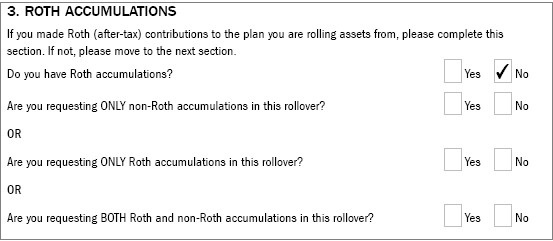
In a different section of the paperwork, you’ll be asked if any of the money in the account is “Roth” (as opposed to traditional). If you are even a little bit unsure, call and ask. The representative will help you pick the correct option. Ask as many questions as you need to, it’s no problem and totally normal:
And you will need to tell Old Provider where they should send the money. You might need to give mailing info for New Provider:

You should ask Old Provider if there is a way to have this entire process be electronic, where no paper checks are sent in the mail. Typically the answer is no, but it is worth asking because that way you could eliminate possible errors/delay with the snail mail process. If they only deal in paper checks, fine. Millions of these transfers happen every year without issue. If it makes you really nervous to have all your funds in temporary limbo, you can transfer funds in smaller chunks.
Old Provider and New Provider will tell you what paperwork to fill out, and they can help you fill it out correctly and tell you exactly how to get them the completed paperwork. After that, Old Provider will most likely prepare a paper check and send it snail mail to New Provider. It will take a week plus for this process to happen. Do check in every few days to see if the funds have arrived at New Provider, then make sure you get that money invested and back into the market, not just sitting as cash.
It is also possible old trustee will mail you a paper check and you are then responsible for mailing that paper check to new trustee. If that happens, you should observe that the check is not made out directly to you. It should say something like “New Provider FBO Your Name.” FBO is an acronym that means For the Benefit Of. For example, if I am rolling old 401k money into an IRA at Vanguard, I would want the check from Old Provider to be for “Vanguard FBO Stephanie Lee Rollover IRA.”
If you do get a paper check mailed to you, don’t delay in sending it to New Provider! You might be able to use mobile deposit, otherwise, you’ll send it on via snail mail. If you wait more than 60 days, the IRS will treat it as an early withdrawal and you’ll be hit with penalties and owe income tax on it. Yikes! One more time: if you get a paper check in the mail, don’t delay in sending it to the New Provider. And, to be clear, if you receive a paper check, do not cash it! Do not endorse it (sign it on the back)! Why not? It is not made out to you, it is made out to New Provider (for your benefit). Just call your New Provider and get exact instructions on where to mail it.
Does it need to be this hard? No, and Congress could and should improve this. Until then, just keep smiling and dialing and remind yourself that you don’t have to do this all that often. The administrative burden is a price Congress decided we should pay to get these tax benefits.
If you have an old account, or maybe multiple old accounts, but feel stuck and want help making a plan, I hope you’ll get in touch.
-Stephanie

