Hi Friendos,
Happy Memorial Day weekend. Many people will pause to remember loved ones who died in military service. I have many relatives who have served, including my paternal grandfather, Robert (Bob) Lee. He’s the fellow on the right here:

That photo was scanned by his cousin who spent 10 years in the Air Force. They both served during World War II. I got a copy of the picture at last year’s family reunion, where I heard stories of tours in Iraq and Afghanistan (and one marriage that did not survive).
Americans bear many personal consequences for our wars, and there is also the financial price. War and taxes and government debt have gone hand in hand throughout history.
Here is a chart from the Congressional Budget Office showing U.S. federal debt over time (I added the purple labels):
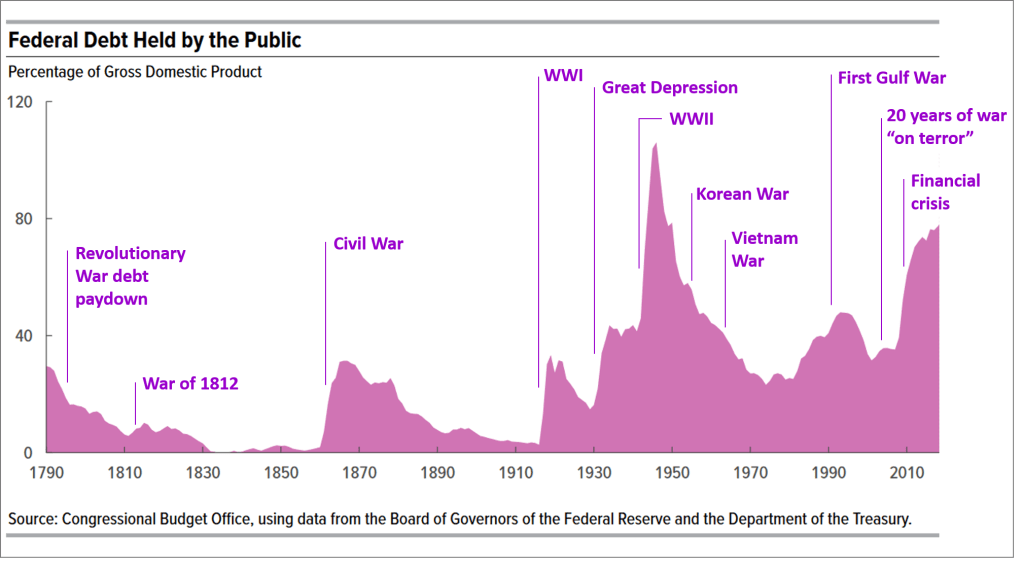
In his 1790 Report on Public Credit, Alexander Hamilton said that “loans in times of public danger, especially from foreign war, are found an indispensable resource, even to the wealthiest” nations and described the debt of the United States as “the price of liberty.”
When we want to spend more than what we currently collect in taxes, we use federal debt to cover the gap. We pay interest on the debt (Treasury bonds) to whomever holds it.
For my entire life interest on the debt and military (“defense”) spending have been among the top five categories of federal government spending, along with Social Security, Medicare, and Medicaid. Here is a chart showing these federal spending categories as a percentage of GDP:
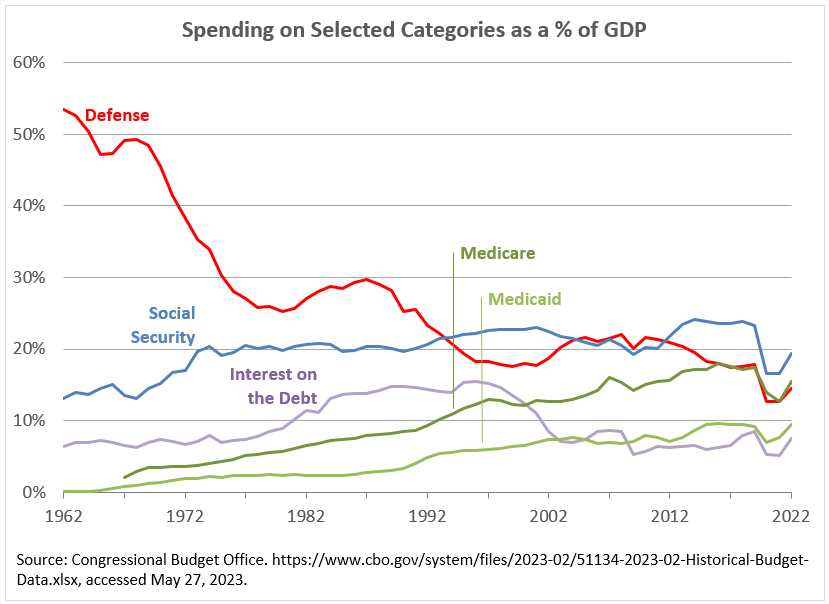
The years on the left are during the Vietnam War. Here is what Martin Luther King, Jr. said about war spending in his April 4, 1967 speech, “Beyond Vietnam: A Time to Break Silence:”
A few years ago there was a shining moment in that struggle. It seemed as if there was a real promise of hope for the poor — both black and white — through the poverty program. There were experiments, hopes, new beginnings. Then came the buildup in Vietnam and I watched the program broken and eviscerated as if it were some idle political plaything of a society gone mad on war, and I knew that America would never invest the necessary funds or energies in rehabilitation of its poor so long as adventures like Vietnam continued to draw men and skills and money like some demonic destructive suction tube.
Since then, our military spending comprises less of our annual economic activity (as measured by GDP), but is absolutely enormous and far exceeds that of all other countries on earth. I don’t understand why we are unwilling to properly feed and house and provide medical care for all of us here in the U.S, but we never seem to have trouble figuring out how to pay for war.

-Stephanie
 Frequently Taxed Questions